This blog will document the restoration of Cape Dory Typhoon (Weekender) Hull #1044. The Cape Dory Typhoon is a great sailing small-scale 'yacht', and offers a very friendly experience for her captain and crew. The scope of this restoration project will be painting the interior, deck and topsides, as well as fabricating new teak brightwork.

Sunday, November 26, 2017

Cont. Foredeck Work, Cabin Sole, and Second Coat of Primer


November 26, 2017


After a week of weddings - INCLUDING MY OWN! - I got back to work on Joule with an ambitious    to-do list for the day.  I started by water-washing the previous session's epoxy work, specifically: the foredeck recore, the cabin sole, and a couple miscellany.

After the water-washing was completed, I donned the sanding gear (RO sander with 40 and 80-grit paper), and got to work on taking the foredeck recore down so that it was no longer standing proud of  the surrounding deck surfaces.


Through the sanding, I periodically checked the level of the patch to the adjacent deck.  I ended this sanding work with some additional fairing to come.


After vacuuming and solvent-washing the surface of the recently sanded foredeck recore work,  I applied neat epoxy with a foam brush to create a good bonding surface with the thickened epoxy yet to come.  I mixed up a batch of thickened epoxy and applied it to the surfaces, and did so that the surfaces stood proud of the surrounding deck.  In my next opportunity to work on the foredeck, I will sand the faired surfaces down to blend in with the balance.


With the remaining cup of thickened epoxy, I addressed a couple spots on the starboard interior liner, as well as old fastener holes (also on the interior liner) that required filling.


My next order of business would be the cabin sole.  I had just sanded the previous fairing work, vacuumed it, and wiped it down with a solvent.  The forward portion of the cabin sole was not recored, since I had cut out the top skin of the sole to a point where in which I revealed structurally sound core.  However, the forward portion of the cabin sole did have a few not insignificant cracks in its top skin, so I wanted to 'beef' this area up a bit with another layer of 1708 biaxial.  I also decided to apply a layer of glass that extended out to the guide slots in the liner that accepts the vertical partition separating what is typically a portable head.  I will come back to fill the weave and blend the layup in with the surrounding surfaces.


With the water-washing, sanding, fairing, and glass work out of the way, I turned my attention to Joule's hull.  I hand-sanded the hull with 180-grit sheet sandpaper, working my way from the stern and counter to the bow and back.  The goal of sanding here was to knock down the prior primer application and create a surface for a good mechanical bond for second coat of this two-part paint.  I mixed the Interlux Primekote in a 3:1 ratio, set it aside for its 15-minute induction period, and readied the hull surface by vacuuming it and wiping it down with solvent. 
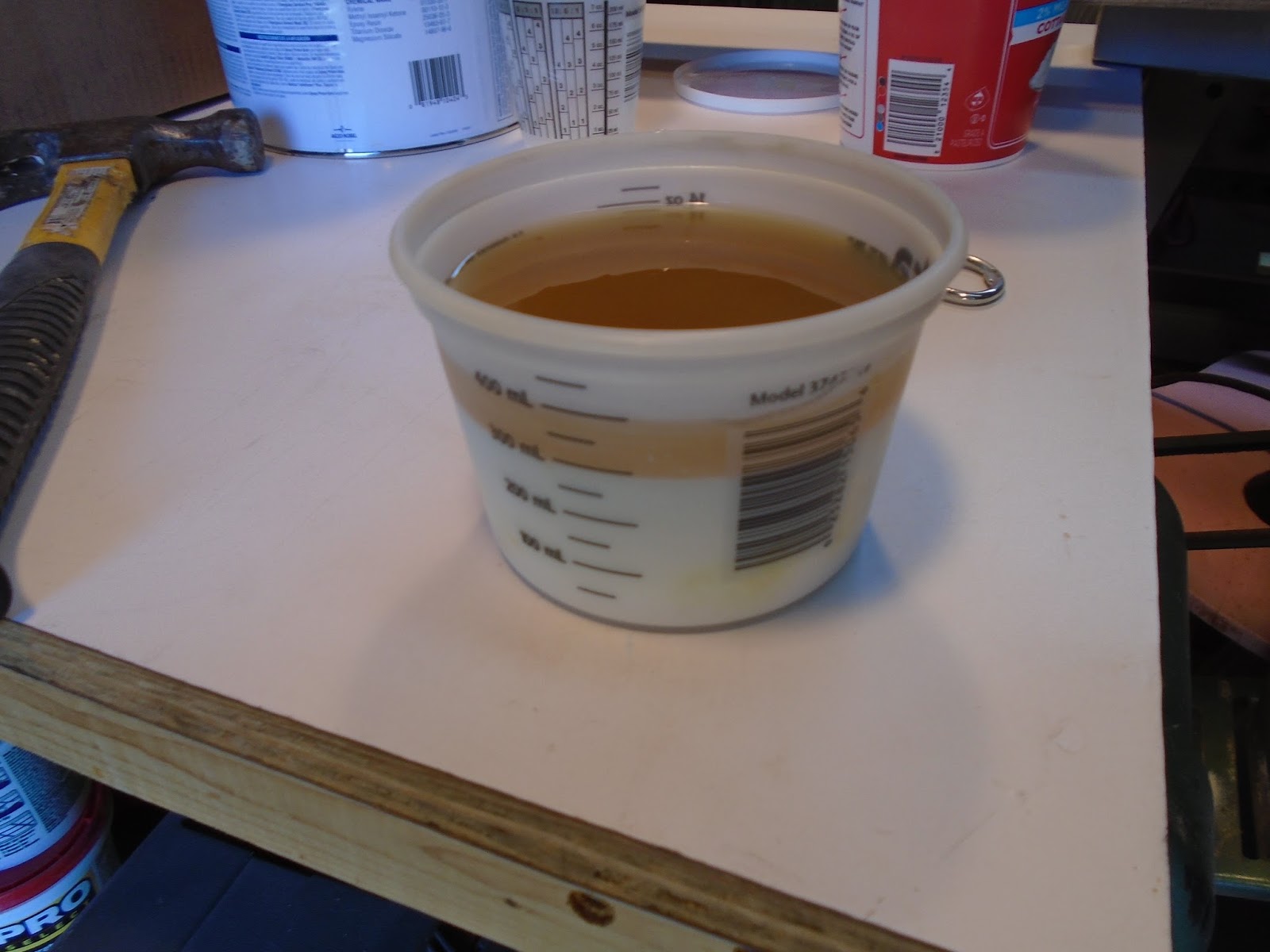


After the 15-minute induction period past, I thinned the primer paint by 20-25% and got to work painting the hull.


I started with the poop deck, and from here went to the stern.


From the stern, I worked my way along the aft portion of the starboard topsides, to the bow, and back to the aft portion of the port topsides.


I have to say, Joule is looking much better that her previous paint scheme!


As I finished the topsides, I moved over to the prepped companionway hatch.


I ended up applying two coats of the primer before calling it a day.


Total Time Today: 6.5 hrs.

Wednesday, November 15, 2017

Cont. Foredeck Recore

November 15, 2017


Picking up where I left off on the recoring work on the foredeck, I solvent-wiped the G10 core material, wet out the surfaces of the bottom skin and surrounding balsa core with neat epoxy, and then mixed another batch of thickened epoxy.  I pushed the thickened epoxy around to the opening in the deck to cover the bottom skin liberally, as well as the sides of the balsa core, and then placed the G10 core material firmly into the bed of epoxy.

As the epoxy squeezed up around the sides of the G10 material, I then used a squeegee to smooth of the surface - it actually took another ounce of thickened epoxy to achieve this, but the top of the new core material was in plane with the tapered edge of the deck.


I then wet out the cloth that would form the new top skin.  I placed the large piece covering the entire surface of the new coring as well as the tapered edges, and then one piece each to port and starboard to help form the raised nonskid surface.  I initially thought it would require two thinner strips to port and starboard to build the raised nonskid deck.  After placing an additional strip on the starboard side, I could tell that the surface was now proud of the deck, and using fairing compound would be significantly easier than sanding off a layer of glass.


I covered the area in plastic sheeting and weighted it for the curing process.


Shop dog helped me close for the evening.


Total Time Today: .75 hrs

Tuesday, November 14, 2017

Recor-ing the Foredeck

November 14, 2017


Arriving home from work, I changed and went straight to work on Joule's foredeck in an attempt to get things laid up today.  Alas, it wasn't to be, but I did make good progress.

I took some measurements of the G10 material that I had in the shop, and used that to more or less determine a rough dimension for the removal of the top skin.  In the photo below, the larger hole in the deck served as an inspection point for the condition of the core - it was in need of replacing.  


I transferred the measurements of the G10 (to serve as the new core material) to the deck, knowing that I could always cut a larger opening if the first cut did not get past bad core material.  


After making the outline cut, I proceeded to make a few additional cuts in the field to aide in removal of the top skin.  I was able to achieve good, solid core just outside a ~1" diameter from the original fastener holes, so I called it good.  I then removed the remaining bits and pieces of glass and balsa core with the oscillating tool, followed by a good sanding to remove the last of the finer material remaining.  


I then used the 4" angle grinder to taper the edges out to accept the new fiberglass top skin.  Before moving on, I thoroughly vacuumed the surfaces and then wiped them down with solvent to prep for new work.
Before moving on, I took a measure from the stem fitting to the original fastener holes for future reference - not intending to attempt to drill and tap new fastener holes in the same location, but so that I can slightly alter the new installation to avoid these original holes.


I brought the G10 slabs out for a test fit, and was a bit disappointed that it wasn't quite a perfect fit, but well enough.  You know what they say, "perfect is the enemy of good."


At this point, I used plastic sheeting to create patterns for the new top skin installation.  In testing the G10 fit, I determined that a bed of thickened epoxy would be applied to the bottom skin, I would then place the G10 core firmly in the bed of thickened epoxy - which will bring the top of the G10 in plane with the original top skin surrounding it.  I will lay one layer of 1708 across the entire surface, and then come back with one to two narrower strips of cloth to starboard and port of the center-line to help create the raised nonskid area.  Some fairing will no doubt be called for, but this plan should get me well on my way. 


Since I was fast losing sunlight, knowing that I could not comfortably continue, I decided to secure the large hole in the foredeck with plastic sheeting. 


Back in the shop, I did get to roughing up the surface the G10 core material, creating a surface for good mechanical bonding, and also cut out the patterns for the 1708 biaxial cloth that is to become the new top skin.


Total Time Today: 1.75 hrs