This blog will document the restoration of Cape Dory Typhoon (Weekender) Hull #1044. The Cape Dory Typhoon is a great sailing small-scale 'yacht', and offers a very friendly experience for her captain and crew. The scope of this restoration project will be painting the interior, deck and topsides, as well as fabricating new teak brightwork.

Saturday, November 11, 2017

Cont. Cabin Sole (Final Layer of Glass), Fairing Topsides and Sanding Cockpit


November 11, 2017


After a much needed mowing of the lawn, I got straight to Joule with intentions of finishing up the cabin sole recore work, among some other miscellaneous items.

The first things to do was to water-wash the spot-filled areas on the topsides and the previous fairing application on the cabin sole.  I scrubbed the surfaces down with water and a scouring pad, and then dried them off.  Using a combination of hand and the RO sander with a 120-grit pad, I took the epoxy down to a fair surface with the surrounding topsides surfaces.


...both port and starboard sides.


While I had the sanding gear out, I went ahead and cleaned up the surfaces of the newly cut portlight openings.  Of course, I also scrubbed the previous fill work to remove the amine blush.


Sanding the portlight openings were mostly done by hand, for obvious reasons, and generally cleaned up on the cabin exterior and interior surfaces with the RO sander.  Later in the evening, I solvent cleaned these surfaces and brushed a layer of neat epoxy to further seal the epoxy fill work. 


With the portlights and hull sides addressed, I went to work on the cabin sole.  The previous fill work progressed the recore along nicely, but since I wanted to layup one more layer of 1708 biaxial to tie in the entire sole surfaces, I did not obsess over the fairness of the surface.  As it turns out, I did not have too many low spots to rework with fairing filler.  I sanded the surface down with the RO sander and 80-grit pads.


With the surface of the cabin sole sanded, I vacuumed and wiped it down with a solvent exceedingly well.  I then prepped the surface for that final layer of glass by filling the spot areas that required it as well as the forward section of the sole that did not require recording work.


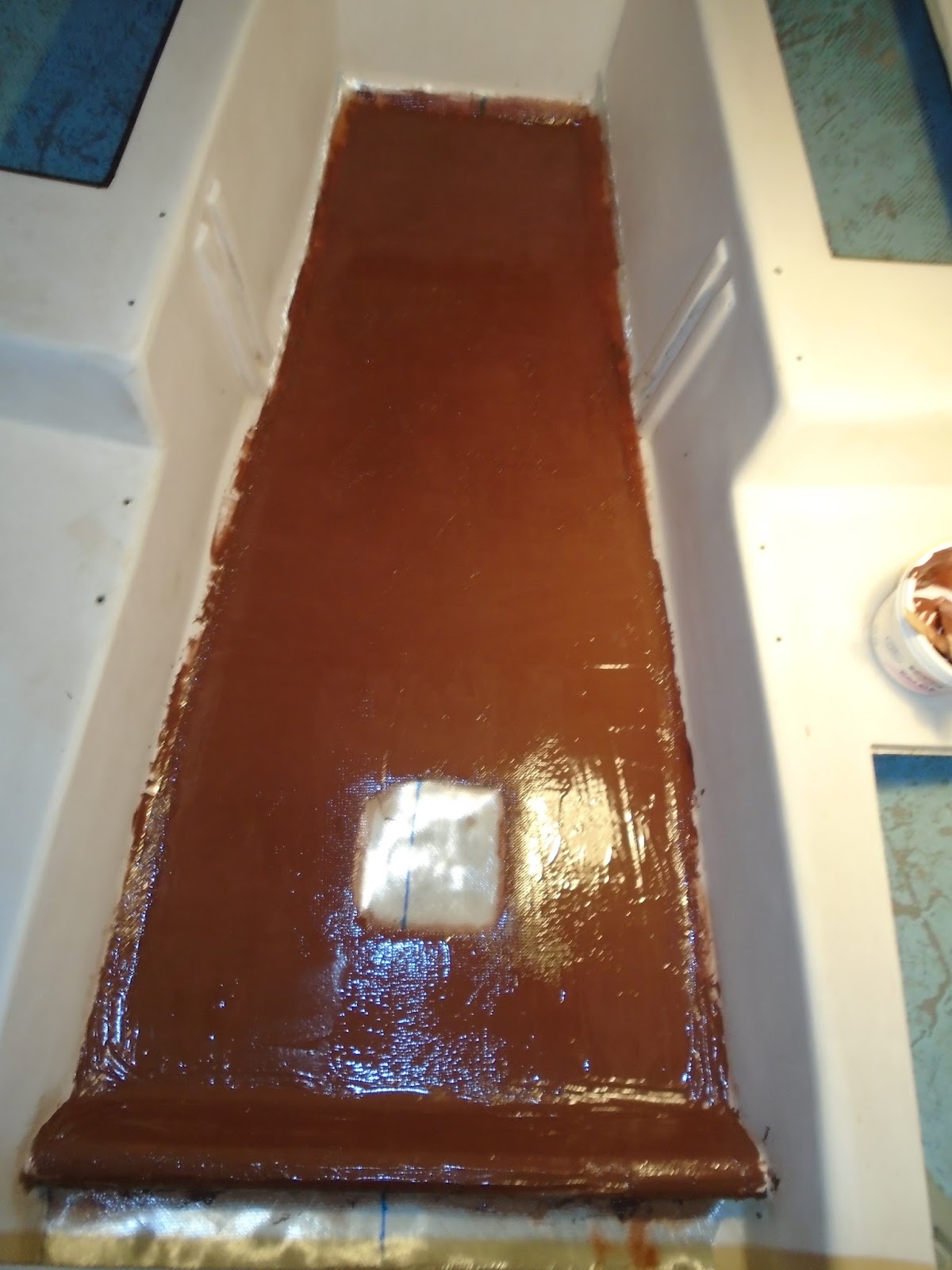
I had taken measurements prior to spot-filling, and so then now took those measurements to the shop to cut that final layer of 1708 biaxial.  My approach was to cut a slightly larger piece of cloth to fit the cabin sole, bend the edges up the sides of the molded seating, and just wet out the sole and radius of the turn from sole to sides of the molded seating.  The sides fit nicely within the radius, the forward end was slightly longer than required, and then I purposely went longer on the aft end in order to tie the sole into the 'damn' molded into the cabin sole.


With the glass fully wet out at this point, I used a fin roller to ensure good adhesion and no air bubbles remained within the laminate.


My final item for the core today was to allow things to tack up a bit, and then fill in the weave with some thickened epoxy.  Filling in the weave at this point is much easier than allowing the glass to set up, water-wash, sand, and then fill it in.  With filling the weave in now, I reduce a few steps and create a chemical rather than mechanical bond for the thickened epoxy.


Total Time Today: 4.25 hrs

Sunday, November 5, 2017

Cont. Cabin Sole (Fairing) and Topsides Spot Fairing

November 5, 2017

I managed to get a bit of time on Joule today, and went straight back into the cabin to check the lamination work I had done last night.  The new cabin sole is sturdy and strong.  The next phase will be to fill in the weave of the 1708 biaxial cloth and generally fair the surface to a satisfactory result.  I say "satisfactory" because I intend to lay a final layer of 1708 over this faired surface to tie into the forward portion of the cabin sole and also to wrap this final layer over the raised portion aft of the bilge access.   

To start the day, I began by water-washing the surface to remove amine blush.  After drying the surface, I sanded the recent lamination with the RO sander and 80-grit discs.


After the sanding was completed, I vacuumed the surface well and followed that with a wipe down with a solvent.  The surface was prepped for fairing compound.


Being a high-traffic area, I used my typical recipe of 406 silica and 407 low-density fillers to thicken the epoxy in order to spread it in a controlled manner.  I used a 6" drywall knife to apply the thickened epoxy and then hit the tighter radius areas with a small plastic squeegee.  I thought about applying the final layer of glass for a hot minute, but ultimately decided to pump the brakes and sand this application of thickened epoxy prior to laying up the final layer of glass.  Waiting would also allow me to take an accurate template for the layer of glass.


As mentioned in my previous post, I need to come back to the topsides to address a few areas that required some sanding and spot fairing.  The areas requiring further attention are all related to repairs of a prior 'incident'.  Since they are on both port and starboard, at the beam's widest, I would wager dock finger piers or pilings were the culprit.  Then again, Joule may be the victim of a Friday night beer can race gone horribly wrong.  Regardless, I needed to take the questionable material down to solid substrate and then spot fair.  


I used the fine dexterity of finger work as well as the RO sander, with 80-grit paper, to remove the questionable material.  I then removed the sanding debris with solvent and mixed up some thickened epoxy.  The fairing compound I went with this time was West System 410 Microlight - an easily sanded material for fine application.  I will likely follow this up with thin layer of 407 since the 410 likes lighter paint schemes.


The last of the day's to-dos was to sand and fill the companionway hatch.  I worked both the top and underside of the hatch with the RO sander, vacuumed and cleaned the surface with a solvent, and then applied fairing compound comprised of the 410 Microlight.  Finishing the day's work and spending a few minutes organizing the shop, I brought down a couple of the teak boards to begin prepping for fabricating the new brightwork...just around the corner!


Total Time Today: 1.75 hrs

Saturday, November 4, 2017

Cabin Sole Recoring, Deadlights, and Miscellaneous Hatch Work

November 4, 2017


After a quick run up to the big box for a few odds and ends, I got to work on water-washing the amine blush off of the previously cured epoxy work on the cockpit locker lids and the companionway slide hatch.  Because today's work did not focus on the continuation of the hatches (nearly complete as they are), I dried off their surfaces and set them aside for later work.  I am in the early stages of getting primer on Joule - both deck and topsides - and so I needed to address any remaining items that stood in the way of that primer application.  Last week I was able to get the first coat of primer on the topsides, and as a result was able to protect the epoxy work from any UV degradation, but I also found a couple spots that needed some additional attention.  These areas are small, but nevertheless need to be addressed before any further primer coats are applied, or topcoat for that matter.  For today, my intention was to dry-fit the new Spartan deadlights, and this involved expanding the opening to receive the interior diameter of the frame.

I used one of the deadlights to create a template out of some leftover countertop laminate, and then applied the template to the cabin sides to outline the material to be removed.  I used this template to mark the new openings for both starboard and port.


Once I had my cut marks outlined, I grabbed my spiral saw and a newly purchased carbide bit to expand the openings to accept the new bronze deadlights.


After I had removed a majority of the material with the spiral saw, I then finished up with hand-sanding by using a sheet of 40-grit paper.  The new deadlights fit well and fit flush to the cabin sides.


I had taped a sheet of plastic on the interior to catch the fiberglass detritus as I cut the openings, and after having vacuumed up that dust and debris, I solvent-washed the openings to prepare for some fairing work.  


The coring had, at one time in the past, been addressed to prevent rot in the event that water made ingress.  Still, I had some fairing work to do after removing some of the interior and exterior laminate, so I painted out the surfaces with neat epoxy and then followed that with an application of thickened epoxy.  I will come back and fair these openings to then proceed with primer coatings, top coatings and eventual installation of the new ports.


The most significant project on the list today was to get to the installation of the new topskin for the cabin sole.  I also water-washed the previous work and dried all surfaces for the cabin sole.  I then sanded the surfaces with the RO Sander and an 80-grit disc, vacuumed the sanding dust and thoroughly wiped the surfaces down with a solvent to capture any remaining contaminants.

With the surfaces prepped for further work, I applied a sheet of plastic to create templates for the layers of fiberglass that would need to go down to complete the recoring work.


I split the top skin work into two sections: one, forward of the bilge access, and the second aft of the bilge access.  I cut three layers for both of these sections: two interior layers and one layer extending over the interior layers to tie in the tapered grinds of the surrounding original topskin.


I started off by wetting out the substrate, and then applied a skim coat of thickened epoxy to fill in any areas of significance.  With the surfaces prepped, I then laid down the first of two inner layers.  I then moved to wet this layer out with neat epoxy, and quickly followed with the second inner layer.  I finished the inner layer installations by rolling the glass out with a fin roller, removing air bubbles and ensuring good saturation as I went.

I followed the inner layers with the outer layer installation.  Like I had done for the previous layer, I saturated the glass with neat epoxy and rolled it out with the fin roller.  As a final task, I applied a skim coat of thickened epoxy to a portion of the topskin's weave and also filled a couple locations that required it.


Total Time Today: 6 hrs